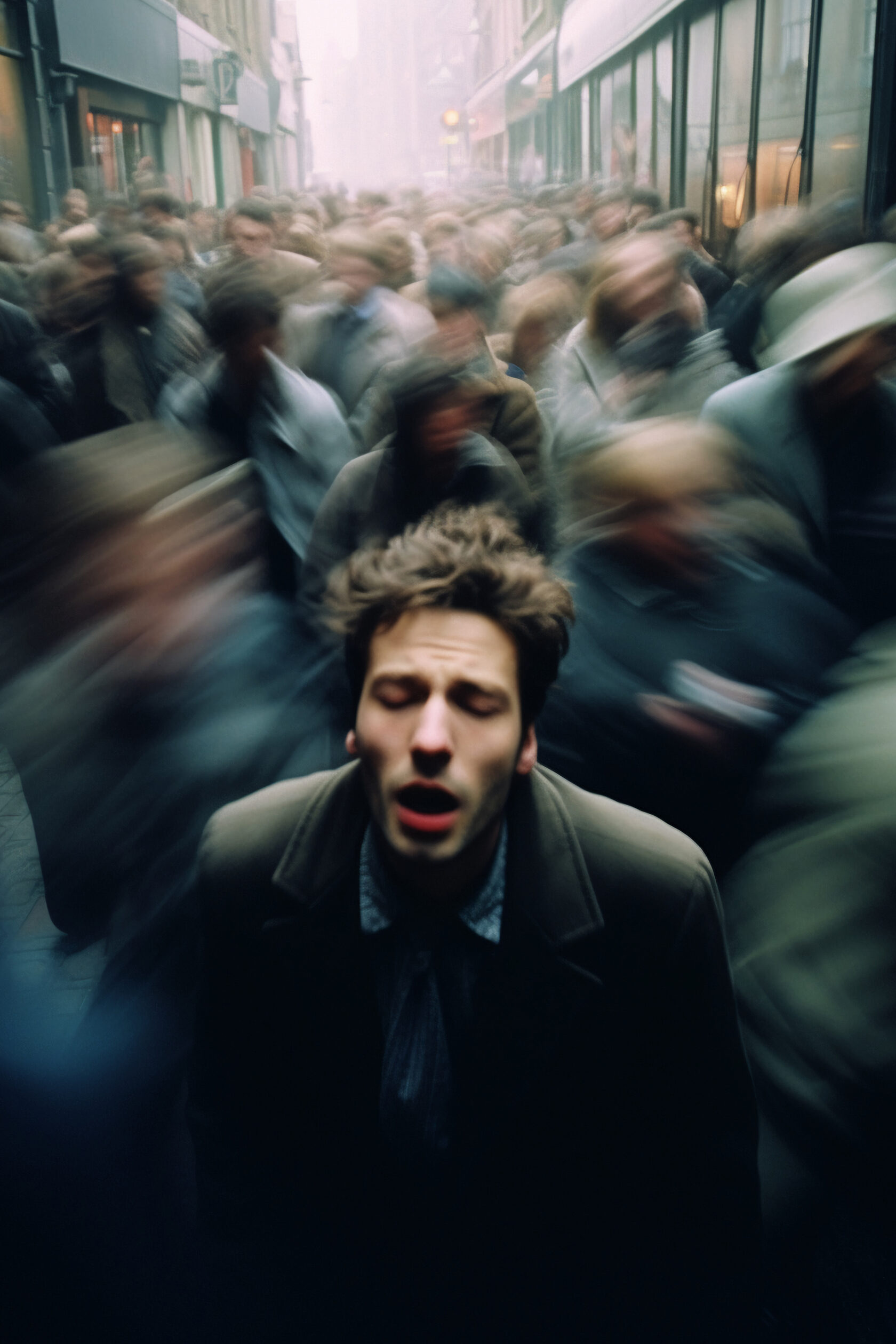
The Fallacy of the Crowd
Over the last ten years or so, there has emerged in western culture a new genealogy of morals. The hyper-morality branch that has come to the fore is powered by an ungodly ideology, an ersatz religion that ignores scriptural reasoning and that threatens its critics with cancel culture. Unlike a theistic religion, all that matters with social justice is that you signal and piously endorse in public (for political convenience) the ‘virtues’ of the ideology. It is therefore akin to a mythology or secular gospel whose practitioners seek false gods. This mythology has saturated western educational institutions resulting in an intellectual vandalism and dishonesty where students have little chance of discovering the truth but are instead spoon-fed ideology and fake moral fervour. The result is that critical thinking has been extinguished at a time when we live in a post-truth, hyper-real clown world where billionaire, alleged paedophiles rule over polarised ‘liberal democracies’ and start unprovoked wars to divert attention away from their heinous crimes.
The social justice ideology aims to create a kind of systemic cognitive dissonance where people refuse to change their beliefs because of the perceived discomfort that it might bring about. Once an ideology can create cognitive dissonance at a systemic level, then it has begun to lay the course for an authoritarian mindset. Discussing tangential themes and writing in the 1930s, the Russian Soviet linguist, Voloshinov, noted: “individual consciousness is not the architect of the ideological superstructure, but only a tenant lodging in the edifice of ideological signs”.[1] It is the crowd that determines the linguistic code but in line with Kierkegaard and with this systemic cognitive dissonance in mind, I would also argue that the “crowd is untruth”. In his essay, The Crowd is Untruth, written at a time when Kierkegaard protested against what he perceived to be the conformism and dogmatic religiosity of the Danish Lutheran Church, Kierkegaard makes his existential critique of mass society.[2] He does this by emphasizing the centrality of the individual as opposed to the crowd which he believes to be fallacious in terms of spiritual and intellectual truths. In this brief essay, he poignantly reminds us that it is precisely for this reason, the crowd is untruth, that Christ was crucified.
Kierkegaard believed that crowds subvert the truth because they crush subjectivism. In the current context of European cultural degradation, the pervading herd morality doesn’t just subvert the truth but replaces critical thinking with virtue signalling. For example, the entire public sector and then subsequently the corporate world embraced the absurdity of the DEI agenda without even questioning it. How many CEOs of major companies stopped to ask why should we discriminate against the British white male population all because a black felon was the victim of police brutality in the US? They must have known the crowd represented the untruth and moral hysteria, but they did not hesitate to jump on the woke bandwagon. People seek the crowd in this manner because it means they can belong to a ‘virtuous’ group (safety in numbers and thus diminished responsibility) and this group membership appears to enhance their social standing. Nietzsche understood that such herd morality is one of the greatest inhibitors to cultural development because if you have to canvass the crowd to see what your ideas might be you create a feeble, risk-averse society (der letzte Mensch). The scars of this herd mentality are now everywhere to be seen: sklavenmoral wokeism and social justice ideological hegemony have resulted in insidious groupthink – the bonfire of critical thinking. Bad decisions are being made without the right kind of ideological-free scrutiny – just look at the flawed and costly decarbonisation of Europe for example.
The problem with these kinds of mass societal norms that underpin this herd mentality is they force people to index inauthenticallycertain values, and this would also have been an affront to Kierkegaard for he wanted people to live authentically. By this he meant, live according to the truth and practice what you preach. Then, peoples’ lives would be meaningful. You turn inwards, act authentically and live out your beliefs – authenticity is not the objective truth, but the subjective truth. Kierkegaard was opposed to his wealthy Danish peers who called themselves Christians, but went to church once a year and never gave to the poor. He believed that such people had no chance of discovering the truth because they were living inauthentically. Similarly, those who subscribe unthinkingly to fake pseudo-values such as ‘diversity’ and ‘inclusion’ are living inauthentically for they are not serving the truth, but instead accommodating an ideological whim. A virtue signaller is not being true to himself and thus has no chance of discovering the truth. He is simply indexing pseudo-values so that he can be perceived to be righteous. A true society made up of individuals behaving authentically might be one where instead people aspired to ‘stoicism’, ‘bravery’ and ‘critical awareness’ for these values are real and trans-generational. There is no moral cowardice here.
If you are self-censoring, biting your tongue because you think speaking out might damage your career, then you too are being inauthentic in the Kierkegaardian sense. You are denying yourself the subjective truth, and thus living in the shadows of soft totalitarianism all so you can get your pension and live out your conventional life in a safe-space. But an inauthentic life is one that is shackled to the repressive Kafkaesque system; you are denying yourself the responsibility of your own existence and that ends in despair or what Kierkegaard called “sickness unto death”. If you want to be a critical thinker, you have to “become one and not many”. As always with Kierkegaard, it feels like an either-or scenario. Being one and not many in the twenty-first century means questioning the groupthink, resisting ideological control, looking inwards to find the truth and speaking up if you feel something is wrong. And then, as Kierkegaard said: “everyone who in truth will serve the truth, is eo ipso in some way or other a martyr” (The Crowd is Untruth). Sadly, this fact will, I suspect, only become apparent at a later stage when European societies degenerate into sectarian violence and voluntary apartheid, and when its citizens seek retrospectively explanations for the lunacy that has unfolded.
But Kierkegaard went one stage further by stating that he believed recognising the “crowd of the court of last resort” was to deny God because crowds can only lead to untruths but God is the truth. So, in Kierkegaardian terms, when we appropriate truth we are appropriating God, but you can only find the truth from within. Kierkegaard thought that we had to seek God for ourselves rather than follow the crowd. And that has been my own recent journey to Orthodox Christianity: lonely at times, but ultimately fulfilling because you appropriate the truth on your terms. It requires commitment and sacrifice which boil down to the same thing. As with all treasures, it is rewarding to find the sacred through your own toils rather than being told where to look for it because it fosters a sense of agency. You enjoy a sense of ownership over your spiritual trajectory and have created a positive feedback loop, as psychologists put it.
According to Kierkegaard, subjectivity is the truth of man who as an authentic being can act as a free agent – unlike philosophy, Christianity teaches us how to become a subject in truth (Concluding Unscientific Postscript).[3] My own spiritual path has been premised entirely on subjective faith and I could only gain that subjectivity when I moved away from the crowd who told me repeatedly: Stiven, tebe eto ne nuzhno (“Stephen, you don’t need this”). Just as man has to achieve greatness alone; the road to salvation must be travelled alone. You don’t need Hegelian systemic thinking, social conformity, rationality or discursive reasoning. In the era of objectivity, there is after all no need for God. Even after becoming Orthodox, my favourite services remain those where I am apart from the crowd and can enjoy the beauty and sacred allure of Orthodoxy as an individual before God. Then, you can rest a while in the pathos and inwardness of understanding. I would never try and persuade someone to become a Christian through analysis of Scripture or preaching. This kind of objectivity dulls the personal interest – the ubique et nusquam in which faith comes into being. I would simply take him or her to vespers at the most beautiful Orthodox church I know, and see if there is any spark from the synaesthetic immediacy and immanence that Orthodoxy expounds. If there is, then perhaps that person can find his or her own path and it will probably be very different from mine. In this regard, you might say that I take the notion of the fallacy of the crowd and the individualism it implies to extremes. I sit in crowded restaurants in Moscow saying grace aloud in Church Slavonic before tucking into my Lenten coulibiac. People stare at me. Not because this is so unusual, but because it is exceptional for a foreigner to do this in Russia. But these tokens of gratitude structure my day and remind me to keep God close in everything I do. Nobody taught me to do these things. It just became part of my lived Orthodox routine.
Kierkegaard believed that “Christianity is spirit; spirit is inwardness; inwardness is subjectivity and subjectivity is a passion for one’s eternal happiness” (Concluding Unscientific Postscript). If you spend any time with monks at Orthodox monasteries, you soon realise that they seek at all times to dwell in this world of interiority and subjectivity. The Kierkegaard way is the Orthodox way. And one of the reasons he told us to be aware of the fallacy of the crowd is that he thought it opposes all these things conducive to a spiritual awakening. By joining the fallacy of the crowd, Kierkegaard believed you might not only be denying yourself the subjective truth, but also the authentic path to God. When I look at the closed-minded thinking that induces the herd morality plaguing currently secular western societies, that is more or less how I see things too.
[1] Marxism and the Philosophy of Language, 1986 [1929]. Translated by Ladislav Matejka and I. R. Titunik. Harvard University Press.
[2] http://www.ccel.org/ccel/kierkegaard/untruth.html. [online edition of The Crowd is Untruth by Søren Kierkegaard]
[3] Concluding Unscientific Postscript. 1944 [1846]. Translated from the Danish by David F. Swenson. Princeton University Press.
Over the last ten years or so, there has emerged in western culture a new genealogy of morals. The hyper-morality branch that has come to the fore is powered by an ungodly ideology, an ersatz religion that ignores scriptural reasoning and that threatens its critics with cancel culture. Unlike a theistic religion, all that matters with social justice is that you signal and piously endorse in public (for political convenience) the ‘virtues’ of the ideology. It is therefore akin to a mythology or secular gospel whose practitioners seek false gods. This mythology has saturated western educational institutions resulting in an intellectual vandalism and dishonesty where students have little chance of discovering the truth but are instead spoon-fed ideology and fake moral fervour. The result is that critical thinking has been extinguished at a time when we live in a post-truth, hyper-real clown world where billionaire, alleged paedophiles rule over polarised ‘liberal democracies’ and start unprovoked wars to divert attention away from their heinous crimes.
The social justice ideology aims to create a kind of systemic cognitive dissonance where people refuse to change their beliefs because of the perceived discomfort that it might bring about. Once an ideology can create cognitive dissonance at a systemic level, then it has begun to lay the course for an authoritarian mindset. Discussing tangential themes and writing in the 1930s, the Russian Soviet linguist, Voloshinov, noted: “individual consciousness is not the architect of the ideological superstructure, but only a tenant lodging in the edifice of ideological signs”.[1] It is the crowd that determines the linguistic code but in line with Kierkegaard and with this systemic cognitive dissonance in mind, I would also argue that the “crowd is untruth”. In his essay, The Crowd is Untruth, written at a time when Kierkegaard protested against what he perceived to be the conformism and dogmatic religiosity of the Danish Lutheran Church, Kierkegaard makes his existential critique of mass society.[2] He does this by emphasizing the centrality of the individual as opposed to the crowd which he believes to be fallacious in terms of spiritual and intellectual truths. In this brief essay, he poignantly reminds us that it is precisely for this reason, the crowd is untruth, that Christ was crucified.
Kierkegaard believed that crowds subvert the truth because they crush subjectivism. In the current context of European cultural degradation, the pervading herd morality doesn’t just subvert the truth but replaces critical thinking with virtue signalling. For example, the entire public sector and then subsequently the corporate world embraced the absurdity of the DEI agenda without even questioning it. How many CEOs of major companies stopped to ask why should we discriminate against the British white male population all because a black felon was the victim of police brutality in the US? They must have known the crowd represented the untruth and moral hysteria, but they did not hesitate to jump on the woke bandwagon. People seek the crowd in this manner because it means they can belong to a ‘virtuous’ group (safety in numbers and thus diminished responsibility) and this group membership appears to enhance their social standing. Nietzsche understood that such herd morality is one of the greatest inhibitors to cultural development because if you have to canvass the crowd to see what your ideas might be you create a feeble, risk-averse society (der letzte Mensch). The scars of this herd mentality are now everywhere to be seen: sklavenmoral wokeism and social justice ideological hegemony have resulted in insidious groupthink – the bonfire of critical thinking. Bad decisions are being made without the right kind of ideological-free scrutiny – just look at the flawed and costly decarbonisation of Europe for example.
The problem with these kinds of mass societal norms that underpin this herd mentality is they force people to index inauthenticallycertain values, and this would also have been an affront to Kierkegaard for he wanted people to live authentically. By this he meant, live according to the truth and practice what you preach. Then, peoples’ lives would be meaningful. You turn inwards, act authentically and live out your beliefs – authenticity is not the objective truth, but the subjective truth. Kierkegaard was opposed to his wealthy Danish peers who called themselves Christians, but went to church once a year and never gave to the poor. He believed that such people had no chance of discovering the truth because they were living inauthentically. Similarly, those who subscribe unthinkingly to fake pseudo-values such as ‘diversity’ and ‘inclusion’ are living inauthentically for they are not serving the truth, but instead accommodating an ideological whim. A virtue signaller is not being true to himself and thus has no chance of discovering the truth. He is simply indexing pseudo-values so that he can be perceived to be righteous. A true society made up of individuals behaving authentically might be one where instead people aspired to ‘stoicism’, ‘bravery’ and ‘critical awareness’ for these values are real and trans-generational. There is no moral cowardice here.
If you are self-censoring, biting your tongue because you think speaking out might damage your career, then you too are being inauthentic in the Kierkegaardian sense. You are denying yourself the subjective truth, and thus living in the shadows of soft totalitarianism all so you can get your pension and live out your conventional life in a safe-space. But an inauthentic life is one that is shackled to the repressive Kafkaesque system; you are denying yourself the responsibility of your own existence and that ends in despair or what Kierkegaard called “sickness unto death”. If you want to be a critical thinker, you have to “become one and not many”. As always with Kierkegaard, it feels like an either-or scenario. Being one and not many in the twenty-first century means questioning the groupthink, resisting ideological control, looking inwards to find the truth and speaking up if you feel something is wrong. And then, as Kierkegaard said: “everyone who in truth will serve the truth, is eo ipso in some way or other a martyr” (The Crowd is Untruth). Sadly, this fact will, I suspect, only become apparent at a later stage when European societies degenerate into sectarian violence and voluntary apartheid, and when its citizens seek retrospectively explanations for the lunacy that has unfolded.
But Kierkegaard went one stage further by stating that he believed recognising the “crowd of the court of last resort” was to deny God because crowds can only lead to untruths but God is the truth. So, in Kierkegaardian terms, when we appropriate truth we are appropriating God, but you can only find the truth from within. Kierkegaard thought that we had to seek God for ourselves rather than follow the crowd. And that has been my own recent journey to Orthodox Christianity: lonely at times, but ultimately fulfilling because you appropriate the truth on your terms. It requires commitment and sacrifice which boil down to the same thing. As with all treasures, it is rewarding to find the sacred through your own toils rather than being told where to look for it because it fosters a sense of agency. You enjoy a sense of ownership over your spiritual trajectory and have created a positive feedback loop, as psychologists put it.
According to Kierkegaard, subjectivity is the truth of man who as an authentic being can act as a free agent – unlike philosophy, Christianity teaches us how to become a subject in truth (Concluding Unscientific Postscript).[3] My own spiritual path has been premised entirely on subjective faith and I could only gain that subjectivity when I moved away from the crowd who told me repeatedly: Stiven, tebe eto ne nuzhno (“Stephen, you don’t need this”). Just as man has to achieve greatness alone; the road to salvation must be travelled alone. You don’t need Hegelian systemic thinking, social conformity, rationality or discursive reasoning. In the era of objectivity, there is after all no need for God. Even after becoming Orthodox, my favourite services remain those where I am apart from the crowd and can enjoy the beauty and sacred allure of Orthodoxy as an individual before God. Then, you can rest a while in the pathos and inwardness of understanding. I would never try and persuade someone to become a Christian through analysis of Scripture or preaching. This kind of objectivity dulls the personal interest – the ubique et nusquam in which faith comes into being. I would simply take him or her to vespers at the most beautiful Orthodox church I know, and see if there is any spark from the synaesthetic immediacy and immanence that Orthodoxy expounds. If there is, then perhaps that person can find his or her own path and it will probably be very different from mine. In this regard, you might say that I take the notion of the fallacy of the crowd and the individualism it implies to extremes. I sit in crowded restaurants in Moscow saying grace aloud in Church Slavonic before tucking into my Lenten coulibiac. People stare at me. Not because this is so unusual, but because it is exceptional for a foreigner to do this in Russia. But these tokens of gratitude structure my day and remind me to keep God close in everything I do. Nobody taught me to do these things. It just became part of my lived Orthodox routine.
Kierkegaard believed that “Christianity is spirit; spirit is inwardness; inwardness is subjectivity and subjectivity is a passion for one’s eternal happiness” (Concluding Unscientific Postscript). If you spend any time with monks at Orthodox monasteries, you soon realise that they seek at all times to dwell in this world of interiority and subjectivity. The Kierkegaard way is the Orthodox way. And one of the reasons he told us to be aware of the fallacy of the crowd is that he thought it opposes all these things conducive to a spiritual awakening. By joining the fallacy of the crowd, Kierkegaard believed you might not only be denying yourself the subjective truth, but also the authentic path to God. When I look at the closed-minded thinking that induces the herd morality plaguing currently secular western societies, that is more or less how I see things too.
[1] Marxism and the Philosophy of Language, 1986 [1929]. Translated by Ladislav Matejka and I. R. Titunik. Harvard University Press.
[2] http://www.ccel.org/ccel/kierkegaard/untruth.html. [online edition of The Crowd is Untruth by Søren Kierkegaard]
[3] Concluding Unscientific Postscript. 1944 [1846]. Translated from the Danish by David F. Swenson. Princeton University Press.
