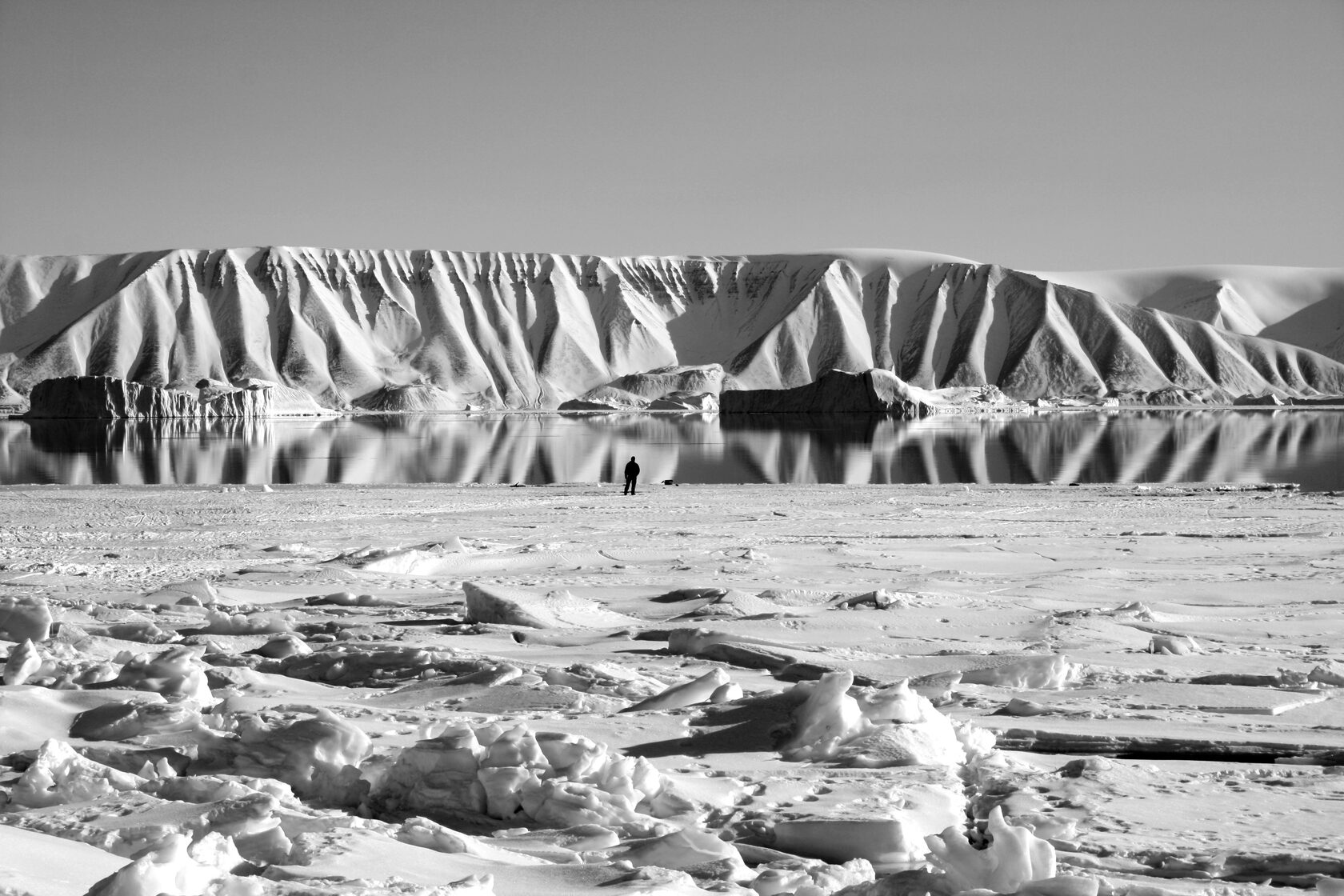
Until recently, there used to be no prisons in Greenland. Instead, it operated an indigenous form of punishment. If someone was convicted of a very serious crime such as homicide, the chances were the assailant would serve his sentence in Denmark. But if it was a less serious crime, the individual was exiled to one of the remote settlements.
The small settlements are not connected by roads. They can only be reached by plane, and the more remote villages such as Savissivik in the north-west corner of Greenland, by helicopter only. If you saw a policeman on one of the turbo-props, he was typically sat next to a criminal, to whom he was handcuffed. He was escorting him to his place of exile. Unable to leave, the criminal would then live in a remote settlement for a period of time. His only way out was the Greenland Ice Sheet, where it is impossible to survive for any amount of time. He was cut off from his family, and this social alienation served as an effective punishment.
In the tiny settlement where I lived for a year (Savissivik, population 40), we housed one such individual. All I knew about him was that he had tried to kill an elderly woman by repeatedly smacking her over the head with a frying pan. Late one evening, just as I was about to go to bed, this individual entered my home (people don’t lock their doors in Greenland). He was very drunk, listing into the furniture. Angry that he had run out of alcohol, he didn’t want to leave empty-handed. On this occasion, my faulty oil heater was for once my saving grace. Complaining of the bitter cold in the hut, the man left, but not before falling down the steps: a miserable pile of sorry limbs in the snow.
This episode came to mind whilst reading Ernst Jünger’s seminal essay The Forest Passage, which celebrates its 75th anniversary this year.[1] Jünger borrowed the term Waldgänger (‘Forest Walker’) from an Old Icelandic legal custom where a criminal was banished to the wilderness and forced to survive alone. With the Norse settlement of Greenland in the tenth century, the Greenlanders apparently copied the Icelandic practice. In the Old Icelandic literature, the skógarmaðr (literally, the ‘forest man’ – the person sentenced to full outlawry), was, despite his crime, considered ‘honourable’ because he had, as Jünger put it, “declared his will to self-affirmation from his own resources”.
The subject of banishment is in part the focus of Ernst Jünger’s The Forest Passage. But the difference between the criminal exile in Greenland and the ‘forest man’ is that the latter gains absolute freedom by marginalisation from what he calls the Leviathan – the totalitarian state – whereas the Greenland criminal remains tied to the ruling apparatus. Jünger emphasizes that a person does not need to “head for the hills”. One can even walk the ‘forest passage’ whilst remaining physically present in a city. The Forest Passage is concerned with the question of how the “beleaguered individual” can maintain internal freedom and moral sovereignty in the face of totalitarianism. Could there be a more relevant book for our times?
The ‘forest’ symbolises the independent thought and freedom that the terror of the state is constantly trying to suppress. It is not necessarily an actual woodland, but serves as a metaphor for the mythological, primal inner space within the human soul that remains completely untouched by Kafkaesque bureaucracy, propaganda and invasive digital technology.
As well as in the Arctic tundra, I found my ‘forest’ on the remote logging tracks of rural Sweden and on the near-abandoned Faroese islands in the middle of the Atlantic. Here, going nowhere could bring you closer to your senses. The senses are the transcendent principle. For the ‘forest man’, the sensuous and the sacred can end up creating a montage of mimetically interwoven voices. They make up speech, which itself can become a liturgical act and offer up a pre-modern subjectivity. In my travels, I have always sought these places that make you look at yourself, where you can find the spiritual foundations of language, the poetics of insight, and the continuity between the Self and the word. In that sense Jünger was right to suggest there are two kinds of history: one in the world of things; the other in the world of language. The second, for which the ‘forest’ can be a prism, contained in his opinion not only the higher insight, but also the more effective power.
Jünger’s essay seems particularly relevant to our times when he writes: “The West is afraid of the East, the East afraid of the West. Everywhere on the planet people live in daily expectation of terrifying attacks, and in many places there is also the fear of civil war.” The apocalypse threatens for sure, but arguably it always did. Jünger’s real concern though is how man can be liberated from this fear. He reminds us that the churches should prepare us for paths that lead into this darkness and the unknown. Instead, the Church of England leads us to the wastelands by hastily dismantling the sacred. We live in a time where ideological conformity informs us that all manner of cultural degradation should be promoted in the name of ‘inclusivity’. Churches have opted for self-persecution. In this respect, Jünger writes: “When all institutions have become equivocal or even disreputable, and when open prayers are heard even in churches not for the persecuted but for the persecutors, at this point moral responsibility passes into the hands of individuals, or, more accurately, into the hands of any still unbroken individuals.”
This passive nihilism that Jünger describes in post-war Germany is precisely that of England today. When will it provoke its active counterpart?, the ‘forest man’ wonders. When will the churches ditch the identity politics and wokeism, and focus again on the sacred and Christ’s teachings? Lack of faith has made the modern, ‘broken’ man gullible and indifferent to the events that have unfolded over the last ten years or so. Unlike the ‘forest man’, he is apparently no longer concerned with the world as a totality. He is part of the ‘crowd’ and will make no sacrifice for his freedom.
Equally prescient, Jünger shows how mass automation fosters fatalism, how the inevitability regarding surveillance leads people to surrender individual sovereignty to the “safety” of the collective. The digital, woke state with its mass surveillance is becoming the Leviathan of our times. In order to survive in parts of the apparatus such as in academia, dissenters have to wear “professional masks”. They dare not venture into the ‘forest’, but instead eke out some kind of shadowy existence in the Nietzschean desert, conscious of the fact that their institutions may be weaponised in the event of civil war.
Jünger thinks of the ‘forest’ as ‘the locus of freedom’ that symbolises the supra-temporal being. He wonders how we should react if we wake up one morning to discover that because of our beliefs (political or otherwise) we find ourselves outside the law. What if we have been ‘banished’ and yet we have not broken any laws? What if the “civilised veneer of life has just changed?” We could all become the skógarmaðr at any moment in time, perhaps just for challenging the ideological dogma. But the process of banishment today would be much more damaging, because man is no longer the “warrior, physician and priest”. The ‘warrior’ had been replaced by the policeman who enforces the orders of the technological apparatus; the physician had become a medical bureaucrat; the priest had become a propagandist for the state.
The ‘forest man’ refuses to trade his personal autonomy and moral clarity for ‘safety’ – that sanctimonious, ideological tool that sterilizes human existence. He wants to break free from the world of mechanical platitudes and return to the ancient wisdom of ‘the forest’ – the themes of the sagas, fairy tales and sacred manuscripts. The ‘forest’ is home, the place of real ‘safety’ (not the ideologically construed one). Here, the ‘forest man’ can conquer fear, build an inner sanctuary and reclaim inner sovereignty. In the forest, he can disconnect his soul from materialism and the surveillance that ekes out the ideological outlaw. He is alone with the everyday historicity of the Faroese farmer and Swedish logger, who use words according to specific circumstances agreed upon by centuries of ancestors. Otherwise, they just stay schtum.
The Forest Passage is not a call to anarchism. It is a plea for people to find the way back to their true selves. In the manner of Hegel, Jünger, says the poets – the real ‘forest rebels’ – lead the way. Now, that we find ourselves in the Leviathan again, the new elite should be dissidents that embody this spirit of free and independent action. These ‘forest people’, who do not permit themselves the aforementioned indifference, will be needed to challenge tyrannical structures and foreign occupiers that oppress the land. The ‘forest man’ should be thought of as an elite: through his example he shows the people how they can become aware of their own native power over the oppressor.
The ‘forest people’s’ arguments will not be listened to, and even when the future of the nation hangs in the balance, the Church and the Establishment will not take their side. Like the exile in Greenland, the forest man will go about his task alone and will have to embrace a new kind of solitude. However, instead of having his ties to the world cut, he preserves his internal sovereignty so that he can practice invisible dissent – and ultimately act as a catalyst to overthrow tyranny.
